Roof Pitch Calculator
Quickly calculate roof pitch, slope, angle, and rafter length with this free online tool supporting rise and run, degrees, or pitch ratio.
VisitPublished on:
May 5, 2026
Pricing:
About Roof Pitch Calculator
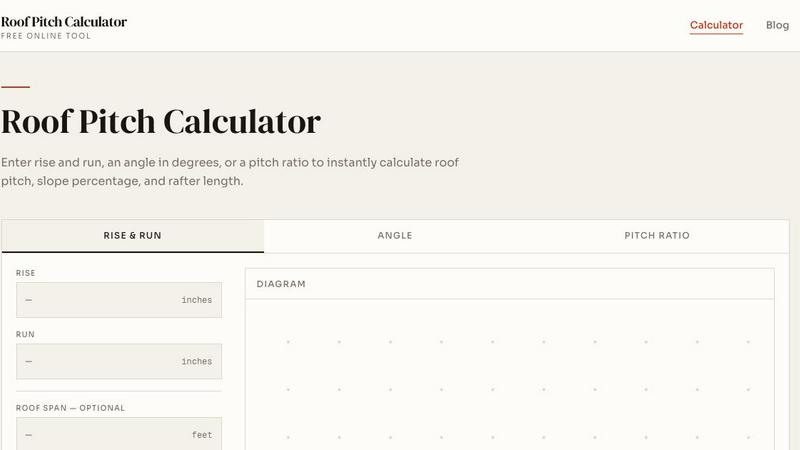
Roof Pitch Calculator is a comprehensive, free online tool designed for homeowners, contractors, roofers, and DIY enthusiasts who need accurate roof pitch measurements and calculations. This powerful application eliminates the complexity of manual roof calculations by offering three distinct input methods: you can enter the rise and run in inches, specify an angle in degrees, or input a pitch ratio in the standard X:12 format. The tool instantly computes and displays the pitch ratio, angle in degrees, slope percentage, rafter multiplier, and rafter length. What sets Roof Pitch Calculator apart is its inclusion of a live SVG roof diagram that updates in real-time as you enter values, providing a visual representation of your roof structure. The product also features a comprehensive reference chart covering over 20 common roof pitches, complete with their corresponding angles, slope percentages, rafter multipliers, categories, and common uses. For those seeking deeper knowledge, the integrated blog section contains detailed guides on roofing topics. All calculations run entirely within your browser with no account creation required, no advertisements displayed, and no hidden costs. The tool is completely free to use, making professional-grade roof calculations accessible to everyone, whether you are planning a new construction project, replacing an existing roof, or simply exploring design options for a shed or addition.
Features of Roof Pitch Calculator
Three Input Methods for Maximum Flexibility
Roof Pitch Calculator offers three distinct ways to input your roof data: Rise and Run, Angle in Degrees, and Pitch Ratio (X:12). This versatility means you can work with whatever measurements you have available. If you have measured the vertical rise and horizontal run, simply enter those values. If you know the roof angle from a blueprint or measurement tool, use the Angle input. For those familiar with standard pitch notation, the Pitch Ratio input accepts values like 4:12 or 6:12. All three methods instantly calculate and display the same comprehensive set of results, ensuring you never need to convert between measurement systems manually.
Live SVG Roof Diagram
One of the most powerful features of Roof Pitch Calculator is the interactive SVG roof diagram that updates in real-time as you enter or change values. This visual representation shows the roof profile with labeled rise, run, and rafter dimensions, making it easy to understand the geometry of your roof. The diagram scales dynamically to accurately reflect the proportions of your specific pitch, helping you visualize the slope before any construction begins. This feature is particularly valuable for homeowners who may struggle to conceptualize abstract numbers, as it provides an immediate, intuitive understanding of how steep or shallow a given pitch will appear on an actual structure.
Comprehensive Reference Chart
The tool includes an extensive reference chart featuring more than 20 common roof pitches, each listed with its pitch ratio, corresponding angle in degrees, slope percentage, rafter multiplier, category classification (Flat, Low, Conventional, or Steep), and common use cases. This chart serves as an invaluable quick-reference guide for professionals and homeowners alike. For example, you can see at a glance that a 4:12 pitch (18.43 degrees) is the minimum for asphalt shingles, while a 6:12 pitch (26.57 degrees) is the most common residential pitch. The chart helps users make informed decisions about which pitch is appropriate for their specific roofing material and architectural style.
Integrated Blog with Expert Guides
Roof Pitch Calculator features a dedicated blog section with professionally written articles covering essential roofing topics. Articles include "Shed Roof Pitch Calculator: How to Choose and Calculate the Right Pitch," "How Do I Calculate Roof Pitch? 4 Methods Explained," and "How to Calculate Roof Pitch Factor (Rafter Multiplier) Explained." Each article provides step-by-step instructions, practical examples, and expert advice. This educational content transforms the tool from a simple calculator into a complete learning resource, helping users understand the underlying principles of roof geometry and make better decisions for their projects.
Use Cases of Roof Pitch Calculator
Residential Roof Replacement and New Construction
Homeowners planning a roof replacement or building a new home can use Roof Pitch Calculator to determine the exact pitch of their existing roof or to specify the desired pitch for a new structure. By entering the rise and run measurements taken from the attic or exterior, they can instantly know the pitch ratio, angle, and slope percentage. This information is critical for selecting the appropriate roofing materials, as different materials have minimum pitch requirements. For example, asphalt shingles require a minimum 4:12 pitch, while metal roofing can be installed on lower slopes. The tool also calculates rafter length, which is essential for ordering the correct amount of lumber and estimating material costs accurately.
Contractor and Roofer Professional Use
Professional contractors and roofers can rely on Roof Pitch Calculator for quick, accurate calculations on job sites or in the office. The tool eliminates the need for manual mathematical formulas and reduces the risk of costly errors. When bidding on projects, contractors can use the calculator to determine rafter lengths, pitch factors, and material quantities with confidence. The comprehensive reference chart is especially useful when discussing options with clients, as it provides clear, visual data about different pitch options and their implications for cost and appearance. The tool works entirely in the browser, so no software installation is needed, making it accessible from any device including smartphones and tablets on the job site.
Shed and Outbuilding Design
DIY enthusiasts building sheds, workshops, or other outbuildings will find Roof Pitch Calculator invaluable for designing the perfect roof. The tool helps users understand how different pitch ratios affect the overall look and functionality of a small structure. For example, a low 3:12 pitch might be appropriate for a storage shed where vertical space is limited, while a steeper 8:12 pitch could create additional loft storage in a workshop. By inputting the desired rise and run or pitch ratio, users can instantly see the resulting angle and rafter length, allowing them to plan their lumber purchases and construction sequence accurately. The live diagram feature helps visualize how the roof will look on their specific building dimensions.
Architectural and Design Planning
Architects, designers, and students can use Roof Pitch Calculator as a quick reference and validation tool during the design phase of projects. When working on new home designs, additions, or renovations, they can experiment with different pitch ratios to achieve specific aesthetic goals or to meet local building code requirements. The tool's ability to convert between pitch ratio, degrees, and slope percentage is particularly useful when coordinating with structural engineers or presenting designs to clients. The reference chart of common pitches provides a starting point for discussions about architectural styles, from low-slope modern designs to steep Victorian or Gothic revival roofs. The calculator ensures that design decisions are grounded in accurate mathematical data.
Frequently Asked Questions
What is roof pitch?
Roof pitch is the measure of how steep a roof is, expressed as the ratio of vertical rise to horizontal run. It is most commonly written as X:12, where X represents the number of inches the roof rises for every 12 inches of horizontal run. For example, a 6:12 pitch means the roof rises 6 inches for every 12 inches of horizontal distance. Roof pitch can also be expressed as an angle in degrees or as a slope percentage. Understanding roof pitch is essential because it affects material selection, drainage efficiency, structural load capacity, and the overall appearance of a building.
How do I calculate roof pitch?
To calculate roof pitch, you need two measurements: the rise (vertical height) and the run (horizontal distance). Measure the vertical distance from the top of the wall to the roof peak, and the horizontal distance from the wall to the point directly under the peak. Divide the rise by the run, then multiply by 12 to get the pitch ratio (X:12). For example, if the rise is 48 inches and the run is 96 inches, divide 48 by 96 to get 0.5, then multiply by 12 to get a 6:12 pitch. You can also use Roof Pitch Calculator, which does all these calculations instantly with just your input values.
What is a good roof pitch for a house?
The best roof pitch for a house depends on climate, architectural style, and roofing material. In most residential areas, a 6:12 pitch (26.57 degrees) is considered the most common and versatile, offering good drainage and a classic appearance. For areas with heavy snow, steeper pitches of 8:12 or higher are recommended to prevent snow accumulation. In warmer climates, lower pitches of 4:12 to 5:12 are common. The minimum pitch for asphalt shingles is 4:12, while metal roofs can be installed on pitches as low as 2:12. Consult the reference chart in Roof Pitch Calculator to compare options and find what works best for your situation.
How do I convert roof pitch to degrees?
To convert roof pitch to degrees, use the arctangent (inverse tangent) function. First, divide the rise by the run to get the slope ratio. For a 6:12 pitch, divide 6 by 12 to get 0.5. Then, find the arctangent of 0.5, which equals approximately 26.57 degrees. The formula is: degrees = arctan(rise / run). Roof Pitch Calculator performs this conversion automatically. If you input a pitch ratio like 6:12, the tool instantly displays the corresponding angle in degrees, saving you the trouble of manual trigonometric calculations.
Similar to Roof Pitch Calculator



PDFKing
Free all-in-one online PDF toolkit to convert, compress, merge, split, edit, organize and protect PDF files quickly and securely.