
Kelda
Kelda cross-references your labs, medications, symptoms, and wearable data to reveal hidden health patterns and connections.
Visit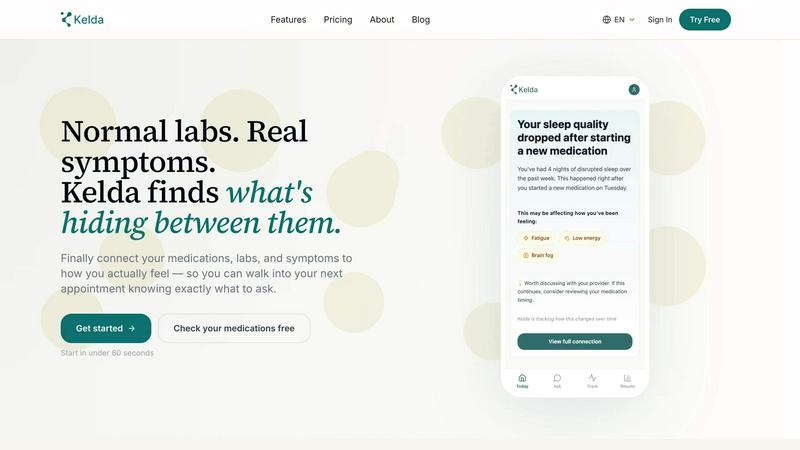
About Kelda
Kelda is a health and wellness platform designed to help individuals understand the complex connections between their medications, nutrients, biomarkers, symptoms, and overall wellbeing. The platform addresses a critical gap in modern healthcare: while standard lab results may appear "within range," they often fail to capture the full picture of how a person actually feels. Kelda brings together labs, medications, symptoms, and wearable data in one unified place, enabling users to identify hidden patterns that are easy to miss in fragmented care. The platform is built for anyone who has seen multiple doctors, undergone numerous tests, and still feels stuck with unexplained symptoms like fatigue, brain fog, mood changes, or sleep disturbances. Kelda is particularly valuable for individuals managing chronic conditions such as PCOS, hypothyroidism, iron deficiency, B12 deficiency, endometriosis, perimenopause, fibromyalgia, insulin resistance, IBS, Hashimoto's, chronic fatigue, anxiety, depression, migraines, and autoimmune conditions. By cross-referencing medications with known nutrient depletion patterns, lab markers with optimal ranges, and symptoms with medication timing, Kelda helps users move from confusion to clarity. The platform publishes clear, research-informed content on medication depletion patterns, lab markers, nutrient interactions, supplement timing, and common health questions. This empowers users to make better-informed decisions and have more productive conversations with their healthcare providers. Kelda simplifies complex health information, making it easier to explore how prescriptions, vitamin status, and lab results relate to energy, mood, metabolism, and long-term health patterns.
Features of Kelda
Medication to Nutrient Depletion Analysis
Kelda automatically cross-references your medications against a comprehensive database of known nutrient depletion patterns. For example, the platform can identify that omeprazole may deplete magnesium, which is commonly linked to fatigue, cramps, and poor sleep. It also checks for other drug-induced deficiencies such as B12 depletion from metformin, folate depletion from birth control, and CoQ10 depletion from statins. This feature helps users understand why they might be experiencing certain symptoms despite having "normal" labs.
Optimal Range Analysis for Biomarkers
Unlike standard lab reports that only flag results outside the normal reference range, Kelda compares your biomarkers against optimal ranges. For instance, if your ferritin level is 25, your doctor may say it is normal, but Kelda identifies that optimal starts at 70 for preventing hair loss and maintaining energy levels. This feature provides a more nuanced and actionable interpretation of lab data, highlighting areas where improvement could significantly impact wellbeing.
Symptom and Wearable Data Pattern Detection
Kelda integrates data from your symptoms and wearable devices to detect patterns that might otherwise go unnoticed. The platform can identify correlations such as a drop in sleep quality after starting a new medication, or a shift in energy and mood occurring simultaneously. This feature enables users to see how their daily experiences connect to their medication regimen and lab results, providing a holistic view of their health.
Comprehensive Condition and Interaction Mapping
Kelda maps your health data across a wide range of conditions and underlying physiological mechanisms. This includes common conditions like PCOS, hypothyroidism, and iron deficiency, as well as more complex issues such as drug-induced nutrient depletion, thyroid conversion failure, CYP enzyme inhibition, HPA axis dysregulation, methylation deficiency, copper-zinc imbalance, oxalate accumulation, and serotonin precursor depletion. The platform identifies connections between seemingly unrelated symptoms and conditions, helping users and their providers see the bigger picture.
Use Cases of Kelda
Identifying Hidden Causes of Chronic Fatigue
A user experiencing persistent fatigue despite normal lab results can use Kelda to cross-reference their medications and biomarkers. The platform might reveal that their proton pump inhibitor is depleting magnesium and B12, or that their ferritin level, while technically "normal," is below the optimal threshold for energy production. This insight allows the user to discuss targeted supplementation or medication adjustments with their doctor, potentially resolving the fatigue that standard medical workups missed.
Connecting Medication Changes to Sleep and Mood Shifts
When a user notices their sleep quality and mood have declined since starting a new medication, Kelda can analyze the timing and identify potential links. The platform might detect that the medication is known to affect serotonin precursors or cortisol regulation. By presenting this pattern clearly, the user can approach their healthcare provider with specific data and questions, leading to a more informed discussion about adjusting the medication or adding supportive therapies.
Unraveling Complex, Multi-Symptom Health Puzzles
For individuals with multiple chronic conditions like PCOS, Hashimoto's, and insulin resistance, Kelda can map the interactions between their various medications and lab markers. The platform might identify a copper-zinc imbalance contributing to hair loss, or a folate trap affecting methylation. This comprehensive view helps users and their doctors understand how different aspects of their health are interconnected, rather than treating each condition in isolation.
Optimizing Nutrient Status During Pregnancy and Postpartum
A user who has been through multiple pregnancies and breastfeeding cycles may experience recurrent infections, rapid skin changes, and persistent fatigue. Kelda can trace these symptoms to cumulative nutrient depletion of zinc, iron, selenium, and other key vitamins and minerals. The platform provides clear, research-backed information on how to address these deficiencies safely while continuing to breastfeed or prepare for future pregnancies, enabling more effective conversations with their obstetrician or midwife.
Frequently Asked Questions
How does Kelda determine what is an "optimal" range versus a "normal" range?
Kelda uses a combination of peer-reviewed research, clinical guidelines, and functional medicine standards to establish optimal ranges for various biomarkers. While standard lab reference ranges are designed to flag disease states, optimal ranges represent the levels at which most people feel their best and experience peak physiological function. For example, a ferritin level of 25 may be within the standard lab range but is below the optimal threshold of 70 for preventing hair loss, fatigue, and cognitive issues. Kelda clearly distinguishes between these two interpretations so users can make informed decisions.
Is Kelda a replacement for medical advice or my healthcare provider?
No, Kelda is not a replacement for professional medical advice, diagnosis, or treatment. The platform is designed as a health companion that helps you organize your data, identify patterns, and prepare for more productive conversations with your healthcare providers. Kelda provides educational resources and research-informed insights, but all medical decisions should be made in consultation with a qualified healthcare professional who can consider your full medical history and individual circumstances.
How does Kelda handle data privacy and security?
Kelda takes data privacy and security seriously. All personal health information, including lab results, medication lists, symptom logs, and wearable data, is encrypted both in transit and at rest. The platform adheres to strict data protection standards and does not share your personal information with third parties without your explicit consent. You have full control over your data and can delete your account and associated information at any time.
What types of medications and conditions does Kelda cover?
Kelda covers a wide range of prescription and over-the-counter medications, including those used for chronic conditions like hypothyroidism, diabetes, hypertension, acid reflux, depression, anxiety, and birth control. The platform also addresses numerous health conditions such as PCOS, endometriosis, perimenopause, fibromyalgia, IBS, Hashimoto's, chronic fatigue, autoimmune conditions, hormonal imbalances, SIBO, and more. Kelda's database is continuously updated with the latest research on drug-nutrient interactions, biomarker optimal ranges, and condition-specific patterns.
Similar to Kelda

DebutPin
Indie product playground — ship products, collect pins for the ones you genuinely like.

Built2WinWeb AI SEO
Custom PHP websites, AI Indexing Pack ($599 one‑time), and WebAgentScan SaaS ($9/mo). MCP, A2A, llms.txt, full ownership.



PDFWix
PDFWix solves the challenge of managing PDF documents by providing free, secure, and easy-to-use tools for editing, converting, compressing and more..
Wisegrid
Wisegrid helps project-driven teams manage projects, workflows, resources, and reporting in a familiar spreadsheet-style workspace.